yum-slop/TaSTT
Free self-hosted STT for VRChat.
git clone https://git.yummers.dev/yum-slop/TaSTT
9fdde29
master
TaSTT: A deliciously free STT
Note: This project is archived and unsupported. Please consider these supported alternatives:
- TTS Voice Wizard - free, uses WhisperCPP and optional cloud backends
- VRCTextboxStt - free, uses the same self-hosted backend as this tool
- RabidCrab's STT - non-free, uses cloud transcription
TaSTT (pronounced "tasty") is a free speech-to-text tool for VRChat. It uses a GPU-based transcription algorithm to turn your voice into text, then sends it into VRChat via OSC.
To get started, download the latest .zip from the releases page.
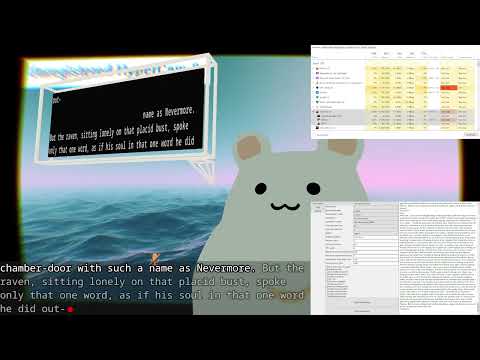
Contents:
Made with love by yum_food.
Usage and setup
Download the latest .zip from the releases page.
Please join the discord to share feedback and get technical help.
To build your own package from source, see GUI/README.md.
Basic controls:
- Short click to toggle transcription.
- Medium click to hide the text box.
- Hold to update text box without unlocking from worldspace.
- Medium click + hold to type using STT.
- Scale up/down in the radial menu.
Design philosophy
- All language services are performed on the client. No network hops in the critical path.
- Priorities (descending order): reliability, latency, accuracy, performance, aesthetics.
- No telemetry of any kind in the app. github and discord are the only means I have to estimate usage and triage bugs.
- Permissive licensing. Users should be legally entitled to hack, extend, relicense, and profit from this codebase.
Features
- Works with the built-in chatbox (usable with public avatars!)
- Customizable board resolution, up to ridiculous sizes.
- Lighweight design:
- Works with VRC native chatbox - works with any avatar without modification
- Custom textbox requires as few as 65 parameter bits
- Transcription doesn't destroy your frames in game since VRChat is heavily CPU bound. Performance impact when not speaking is negligible.
- Performant: uses CTranslate2 inference engine with GPU support and flash-attention
- Browser source. Use with OBS!
- Multi-language support.
- Whisper natively supports transcription in 100 languages.
- A local translation algorithm (Meta's NLLB) enables translating into 200 other languages with good-ish accuracy (BLEU scores typically around 20-35) and low latency.
- Customizable:
- Control button may be set to left/right a/b/joystick.
- Text filters: lowercase, uppercase, uwu, remove trailing period, profanity censoring.
- Many optional quality-of-life features:
- Audio feedback: hear distinct beeps when transcription starts and stops.
- May also enable in-game noise indicator, to grab others' attention.
- Custom chatbox features:
- Free modular avatar prefab available here.
- Resizable with a blendtree in your radial menu.
- Locks to world space either when summoned (default) or when done speaking.
- Unicode variant (supporting e.g. Chinese and Japanese) is available through the app's Unity panel.
- Privacy-respecting: transcription is done on your GPU, not in the cloud.
- Hackable.
- From-scratch implementation.
- Free as in beer.
- Free as in freedom.
- MIT license.
Bad parts
I think that any ethical software project should disclose what sucks about it. Here's what sucks about this project:
- The app UI looks like trash. Only you will see it, so I don't think this really matters. (Electron rewrite when?)
- The app is HUGE. This mostly stems from the bundled NVIDIA CUDNN .dll's
(~1.0GB) and portable git (~500 MB).
- NVIDIA's DLLs should be statically linked into ctranslate2. That probably means doing our own build of ctranslate2... yuck.
- Portable git can probably be stripped down. It includes a full mingw environment responsible for the vast majority of the size, which we almost certainly don't need.
- The app doesn't start automatically with steamvr (TODO do this)
- The app starts in a weird state where it's transcribing and doesn't really back off correctly. Press the controller keybind once to stop transcription then again to put it into a normal state.
- The backend Unity code is pretty gory. (This is largely irrelevant to end users, since end users mostly use the VRC-native chatbox or the modular avatar prefab.) I have a burning disdain for C# so I wrote a scuffed "animator as code" library (libunity.py) in Python. This includes a lot of crazy shit like a multiprocess YAML parser and a ton of macro-like string manipulation/concatenation. We should just use the upstream C# animator as code library.
- The app doesn't include any version numbers, so debugging version-specific issues can be tough (TODO fix this)
Requirements
System requirements:
- ~2GB disk space
- NVIDIA GPU with at least 2GB of spare VRAM.
- You can run it in CPU mode, but it's really slow and lags you a lot more, so I wouldn't recommend it.
- I've tested on a 1080 Ti and a 3090 and saw comparable latency.
- SteamVR.
Avatar resources used by custom chatbox:
- Tris: 12
- Material slots: 1
- Texture memory: 340 KB (English), 130 MB (international)
- Parameter bits: 65-217 (configurable; more bits == faster paging)
- Menu slots: 1
Motivation
Many VRChat players choose not to use their mics, but as a practical matter, occasionally have to communicate. I want this to be as simple, efficient, and reliable as possible.
There are existing tools which help here, but they are all imperfect for one reason or another:
- RabidCrab's STT costs money and relies on cloud-based transcription. Because of the reliance on cloud-based transcription services, it's typically slower and less reliable than local transcription. However, the accuracy and speed of cloud AI models has improved radically since late 2022, so this is probably the best option if money and privacy don't matter to you.
- The in-game text box is not visible in streamer mode, and limits you to one update every ~2 seconds, making it a poor choice for latency-sensitive communication.
- KillFrenzy's AvatarText only supports text-to-text. It's an excellent product with high-quality source code, but it lacks integration with a client-side STT engine.
- I5UCC's VRCTextboxSTT makes KillFrenzy's AvatarText and Whisper kiss. It's the closest spiritual cousin to this repository. The author has made incredible sustained progress on the problem. Definitely take a look!
- VRCWizard's TTS-Voice-Wizard also uses Whisper, but they rely on the C# interface to Const-Me's CUDA-enabled Whisper implementation. This implementation does not support beam search decoding and waits for pauses to segment your voice. Thus it's less accurate and higher latency than this project's transcription engine. It supports more features (like cloud-based TTS), so you might want to check it out.
Why should you pick this project over the alternatives? This project is mature, low-latency (typically 500-1000 ms end-to-end in game under load), reliable, and accurate. There is no network hop to worry about and no subscription to manage. Just download and go.
Design overview
These are the important bits:
TaSTT_template.shader. A simple unlit shader template. Contains the business logic for the shader that shows text in game.generate_shader.py. Adds parameters and an accessor function to the shader template.libunity.py. Contains the logic required to generate and manipulate Unity YAML files. Works well enough on YAMLs up to ~40k documents, 1M lines.libtastt.py. Contains the logic to generate TaSTT-specific Unity files, namely the animations and the animator.osc_ctrl.py. Sends OSC messages to VRChat, which it dutifully passes along to the generated FX layer.transcribe_v2.py. Uses OpenAI's whisper neural network to transcribe audio and sends it to the board using osc_ctrl.
Parameters & board indexing
I divide the board into several regions and use a single int parameter,
TaSTT_Select, to select the active region. For each byte of data
in the active region, I use a float parameter to blend between two
animations: one with value 0, and one with value 255.
To support wide character sets, I support 2 bytes per character. This can be configured down to 1 byte per character to save parameter bits.
FX controller design
The FX controller (AKA animator) is pretty simple. There is one layer for each sync parameter (i.e. each character byte). The layer has to work out which region it's in, then write a byte to the correct shader parameter.

From top down, we first check if updating the board is enabled. If no, we stay in the first state. Then we check which region we're in. Finally, we drive a shader parameter to one of 256 possible values using a blendtree.

The blendtree trick lets us represent wide character sets efficiently. The number of animations required increases logarithmically with the size of the character set:
(N bytes per character) = ceil(log2(size of character set))
(total animations) =
    (2 animations per byte) *
    (N bytes per character) *
    (M characters per region)
Contributing
Contributions welcome. Send a pull request to this repository.
See GUI/README.md for instructions on building the GUI.
Ping the discord if you need help getting set up.
Roadmap
Milestone 1: STT Personally usable
Status: COMPLETE.
Scope: The speech-to-text may be used by one developer intimately familiar with its inner workings. Environment is not encapsulated.
Completed at commit 8326dee0bf01956.
Milestone 2: STT Generally usable
Status: COMPLETE.
Scope: The speech-to-text is used by at least one user not familiar with its inner workings. Dependency management is mostly handled mechanically. The app can be controlled using a GUI.
Completed at commit 1f15133dd985442, AKA release 0.10.0.
Milestone 3: STT Generally performant
Status: COMPLETE.
Scope: The speech-to-text may be used on resource constrained systems.
I'm looking at Const-Me/Whisper as the transcription backend. I have measured terrible accuracy when using the VAD-segmented transcription path vs. using the file-based non-VAD-segmented transcription path (~15x higher edit distance on the same recording of the Bill of Rights). Beam search has not measurably improved the file-based transcription path. It remains to be seen if VAD segmentation is the failure source, or if it's caused by the inference layer being unable to "second guess" itself (previous transcriptions cannot be edited in the current architecture), or something else.
Completed at commit 1f2e5c6cf16e7e7, AKA release 0.11.2.
Milestone 4: Enable non-VRChat use cases
Status: COMPLETE.
Scope: The speech-to-text may be used as a tool for usecases outside of VRChat.
Streamers could use the STT as an OBS browser source. VR players could use it to type into arbitrary text fields (voice-driven keyboard device). MMO players could also use the voice-driven keyboard (speak -> preview -> rapid commit?) while raiding.
Completed at commit 7a576bcac1c37c3, AKA release 0.13.1.
Milestone 5: Integration into other tools
Status: NOT STARTED.
Scope: Integrate performant client-side transcription into other STT tools.
Once performant client-side transcription is implemented, there is no reason to keep it locked away inside one project. Other projects making different tradeoffs (such as relying on cloud services for TTS) could benefit from this functionality, driving down costs and latency for users. In particular, I think that there is value in integrating with TTS-Voice-Wizard.
TaSTT is about providing performant, commoditized, user-owned STT services. I have no interest in using cloud services to provide any functionality. Instead of extending this project to do that, the best way to spread the love is to partner with (contribute to) projects that do.
Completion
This project will probably reach a stable state and then go into maintenance. The efforts described above are the major milestones I plan to implement. Small features and bugfixes will likely continue in the "completed" state.
Backlog
- Better Unity integrations
- Port all scripts to Unity-native C# scripts.
Support appending to existing FX layers.DONE- Use VRCSDK to generate FX layer instead of generating the serialized files.
- In-game usability features.
Resizing (talk to friends far away).DONEBasic toggles (hide it when not needed).DONEWorld mounting (leave it in a fixed position in world space).DONEAvatar mounting (attach it to your hand)DONE.Controller triggers (avoid having to use the radial menu every time you want to speak).DONE
- General usability features.
Error detection & correction.DONEText-to-text interface. Type in terminal, show in game.DONESpeech-to-text interface. Speak out loud, show in game.DONETranslation into non-English. Whisper natively supports translating N languages into English, but not the other way around.DONE- Display text in overlay. Enables (1) lower latency view of TaSTT's transcription state; (2) checking transcriptions ahead of time; (3) checking transcriptions without having to see the board in game.
- TTS. Multiple people have requested this. See if there are open source algorithms available; or, figure out how to integrate with
Save UI input fields to config file. Persist across process exit. It's annoying having to re-enter the config every time I use the STT.DONECustomizable controller bindings. Someone mentioned they use left click to unmute. Let's work around users, not make them change their existing keybinds.DONE- One-click upgrade. Fetch latest stable release, copy over virtual env and UI configs, relaunch.
Browser source for OBS. Blocker: the transcription layer doesn't handle long pauses well.DONE- Test suite. Some long representative transcripts with mechanical word error rate (WER) calculation.
- Optimization
Utilize the avatar 3.0 SDK's ability to drive parameters to reduce the total # of parameters (and therefore OSC messages & sync events). Note that the parameter memory usage may not decrease.DONEOptimize FX layer. We have 14k animations and a 1.2 million line FX layer. Something must be rethought to bring these numbers down.DONEImplement multicore YAML parsing. This will make working with large animators much more practical.DONETranscription engine sleep interval increases exponentially up to 1-2 seconds, then jumps back to a short interval once speech is detected. This should significantly cut down on idle resource consumption. Perhaps there's even a more efficient way to detect the odds that anything is being said, which we could use to gate transcription.DONE- There are ~64k words in the English language. We could encode each word using a 16-bit int. On the other hand, suppose you represented each character using 7 bits per character and transmitted words character-by-character. The average word length is 4.7 characters, and we send ~1 space character per word. Thus the expected bits per word in an optimized version of today's encoding scheme is (5.7 * 7) == 39.9 bits. The other encoding scheme is thus ~2.5 times more efficient. This could be used to significantly speed up sync times. (Thanks, Noppers for the idea!)
Use Const-Me/Whisper for transcription.WON'T DOImplement beam search in Const-Me/Whisper.WON'T DO
- Bugfixes
The whisper STT says "Thank you." when there's no audio?DONE- JP and CN transcription does not work in the GUI due to encoding issues.
- Shine
- Smooth scrolling.
Infinite scrolling.DONESound indicator, maybe like animal crossing :)DONESupport texture-based PBR shadingDONE
1## TaSTT: A deliciously free STT 2 3Note: This project is archived and unsupported. Please consider these supported 4alternatives: 5 6* [TTS Voice Wizard](https://github.com/VRCWizard/TTS-Voice-Wizard) - free, 7uses WhisperCPP and optional cloud backends 8 * [VRCTextboxStt](https://github.com/I5UCC/VRCTextboxSTT) - free, uses the same 9self-hosted backend as this tool 10 * [RabidCrab's STT](https://vrcstt.com/) - non-free, uses cloud transcription 11 12TaSTT (pronounced "tasty") is a free speech-to-text tool for VRChat. It uses 13[a GPU-based transcription algorithm](https://github.com/openai/whisper) to 14turn your voice into text, then sends it into VRChat via OSC. 15 16To get started, download the latest .zip from [the releases page](https://github.com/yum-food/TaSTT/releases/latest). 17 18[](https://youtube.com/watch?v=tUO1MXN64Mo) 19 20Contents: 21 220. [Usage and setup](#usage-and-setup) 231. [Features](#features) 242. [Requirements](#requirements) 253. [Motivation](#motivation) 264. [Design overview](#design-overview) 275. [Contributing](#contributing) 286. [Roadmap](#Roadmap) 297. [Backlog](#backlog) 30 31Made with love by yum\_food. 32 33## Usage and setup 34 35Download the latest .zip from [the releases page](https://github.com/yum-food/TaSTT/releases/latest). 36 37Please [join the discord](https://discord.gg/YWmCvbCRyn) to share feedback and 38get technical help. 39 40To build your own package from source, see GUI/README.md. 41 42Basic controls: 43* Short click to toggle transcription. 44* Medium click to hide the text box. 45* Hold to update text box without unlocking from worldspace. 46* Medium click + hold to type using STT. 47* Scale up/down in the radial menu. 48 49## Design philosophy 50 51* All language services are performed on the client. No network hops in the 52critical path. 53* Priorities (descending order): reliability, latency, accuracy, performance, 54aesthetics. 55* No telemetry of any kind in the app. github and discord are the only means I 56have to estimate usage and triage bugs. 57* Permissive licensing. Users should be legally entitled to hack, extend, 58relicense, and profit from this codebase. 59 60## Features 61 62* Works with the built-in chatbox (usable with public avatars!) 63* Customizable board resolution, [up to ridiculous sizes](https://www.youtube.com/watch?v=u5h-ivkwS0M). 64* Lighweight design: 65* Works with VRC native chatbox - works with any avatar without modification 66* Custom textbox requires as few as 65 parameter bits 67* Transcription doesn't destroy your frames in game since VRChat is heavily 68CPU bound. Performance impact when not speaking is negligible. 69* Performant: uses CTranslate2 inference engine with GPU support and 70flash-attention 71* Browser source. Use with OBS! 72* Multi-language support. 73* Whisper natively supports transcription in [100 languages]( 74https://github.com/openai/whisper/blob/main/whisper/tokenizer.py#L10). 75* A local translation algorithm (Meta's NLLB) enables translating into 200 76other languages with good-ish accuracy (BLEU scores typically around 20-35) 77and low latency. 78* Customizable: 79* Control button may be set to left/right a/b/joystick. 80* Text filters: lowercase, uppercase, uwu, remove trailing period, profanity 81censoring. 82* Many optional quality-of-life features: 83* Audio feedback: hear distinct beeps when transcription starts and stops. 84* May also enable in-game noise indicator, to grab others' attention. 85* Custom chatbox features: 86* Free modular avatar prefab available [here](https://yumfood.gumroad.com/l/tastt_modular). 87* Resizable with a blendtree in your radial menu. 88* Locks to world space either when summoned (default) or when done speaking. 89* Unicode variant (supporting e.g. Chinese and Japanese) is available 90through the app's Unity panel. 91* Privacy-respecting: transcription is done on your GPU, not in the cloud. 92* Hackable. 93* From-scratch implementation. 94* Free as in beer. 95* Free as in freedom. 96* MIT license. 97 98## Bad parts 99 100I think that any ethical software project should disclose what sucks about it. 101Here's what sucks about this project: 102 103* The app UI looks like trash. Only you will see it, so I don't think this 104really matters. (Electron rewrite when?) 105* The app is HUGE. This mostly stems from the bundled NVIDIA CUDNN .dll's 106(~1.0GB) and portable git (~500 MB). 107* NVIDIA's DLLs should be statically linked into ctranslate2. That probably 108means doing our own build of ctranslate2... yuck. 109* Portable git can probably be stripped down. It includes a full mingw 110environment responsible for the vast majority of the size, which we almost 111certainly don't need. 112* The app doesn't start automatically with steamvr (TODO do this) 113* The app starts in a weird state where it's transcribing and doesn't really 114back off correctly. Press the controller keybind once to stop transcription 115then again to put it into a normal state. 116* The backend Unity code is pretty gory. (This is largely irrelevant to end 117users, since end users mostly use the VRC-native chatbox or the modular 118avatar prefab.) I have a burning disdain for C# so I wrote a scuffed 119"animator as code" library (libunity.py) in Python. This includes a lot of 120crazy shit like a multiprocess YAML parser and a ton of macro-like string 121manipulation/concatenation. We should just use the upstream C# animator as 122code library. 123* The app doesn't include any version numbers, so debugging version-specific 124issues can be tough (TODO fix this) 125 126## Requirements 127 128System requirements: 129 130* ~2GB disk space 131* NVIDIA GPU with at least 2GB of spare VRAM. 132* You *can* run it in CPU mode, but it's really slow and lags you a 133lot more, so I wouldn't recommend it. 134* I've tested on a 1080 Ti and a 3090 and saw comparable latency. 135* SteamVR. 136 137Avatar resources used by custom chatbox: 138 139* Tris: 12 140* Material slots: 1 141* Texture memory: 340 KB (English), 130 MB (international) 142* Parameter bits: 65-217 (configurable; more bits == faster paging) 143* Menu slots: 1 144 145## Motivation 146 147Many VRChat players choose not to use their mics, but as a practical matter, 148occasionally have to communicate. I want this to be as simple, efficient, and 149reliable as possible. 150 151There are existing tools which help here, but they are all imperfect for one 152reason or another: 153 1541. RabidCrab's STT costs money and relies on cloud-based transcription. 155Because of the reliance on cloud-based transcription services, it's 156typically slower and less reliable than local transcription. However, the 157accuracy and speed of cloud AI models has improved radically since late 1582022, so this is probably the best option if money and privacy don't matter 159to you. 1602. The in-game text box is not visible in streamer mode, and limits you to one 161update every ~2 seconds, making it a poor choice for latency-sensitive 162communication. 1633. [KillFrenzy's AvatarText](https://github.com/killfrenzy96/KillFrenzyAvatarText) 164only supports text-to-text. It's an excellent product with high-quality 165source code, but it lacks integration with a client-side STT engine. 1664. [I5UCC's VRCTextboxSTT](https://github.com/I5UCC/VRCTextboxSTT) makes 167KillFrenzy's AvatarText and Whisper kiss. It's the closest spiritual cousin 168to this repository. The author has made incredible sustained progress on 169the problem. Definitely take a look! 1705. [VRCWizard's TTS-Voice-Wizard](https://github.com/VRCWizard/TTS-Voice-Wizard) 171also uses Whisper, but they rely on the C# interface to Const-Me's 172CUDA-enabled Whisper implementation. This implementation does not support 173beam search decoding and waits for pauses to segment your voice. Thus it's 174less accurate and higher latency than this project's 175transcription engine. It supports more features 176(like cloud-based TTS), so you might want to check it out. 177 178Why should you pick this project over the alternatives? This project is mature, 179low-latency (typically 500-1000 ms end-to-end in game under load), reliable, and 180accurate. There is no network hop to worry about and no subscription to manage. 181Just download and go. 182 183## Design overview 184 185These are the important bits: 186 1871. `TaSTT_template.shader`. A simple unlit shader template. Contains the 188business logic for the shader that shows text in game. 1892. `generate_shader.py`. Adds parameters and an accessor function to the 190shader template. 1913. `libunity.py`. Contains the logic required to generate and manipulate Unity 192YAML files. Works well enough on YAMLs up to ~40k documents, 1M lines. 1934. `libtastt.py`. Contains the logic to generate TaSTT-specific Unity files, 194namely the animations and the animator. 1955. `osc_ctrl.py`. Sends OSC messages to VRChat, which it dutifully passes along 196to the generated FX layer. 1976. `transcribe_v2.py`. Uses OpenAI's whisper neural network to transcribe audio 198and sends it to the board using osc_ctrl. 199 200#### Parameters & board indexing 201 202I divide the board into several regions and use a single int parameter, 203`TaSTT_Select`, to select the active region. For each byte of data 204in the active region, I use a float parameter to blend between two 205animations: one with value 0, and one with value 255. 206 207To support wide character sets, I support 2 bytes per character. This 208can be configured down to 1 byte per character to save parameter bits. 209 210#### FX controller design 211 212The FX controller (AKA animator) is pretty simple. There is one layer for each 213sync parameter (i.e. each character byte). The layer has to work out which 214region it's in, then write a byte to the correct shader parameter. 215 216 217 218From top down, we first check if updating the board is enabled. If no, we stay 219in the first state. Then we check which region we're in. Finally, we drive a 220shader parameter to one of 256 possible values using a blendtree. 221 222 223 224The blendtree trick lets us represent wide character sets efficiently. The 225number of animations required increases logarithmically with the size of the 226character set: 227 228``` 229(N bytes per character) = ceil(log2(size of character set)) 230(total animations) = 231(2 animations per byte) * 232(N bytes per character) * 233(M characters per region) 234``` 235 236## Contributing 237 238Contributions welcome. Send a pull request to this repository. 239 240See GUI/README.md for instructions on building the GUI. 241 242Ping the discord if you need help getting set up. 243 244## Roadmap 245 246### Milestone 1: STT Personally usable 247 248Status: COMPLETE. 249 250Scope: The speech-to-text may be used by one developer intimately familiar with 251its inner workings. Environment is not encapsulated. 252 253Completed at commit 8326dee0bf01956. 254 255### Milestone 2: STT Generally usable 256 257Status: COMPLETE. 258 259Scope: The speech-to-text is used by at least one user not familiar with its 260inner workings. Dependency management is mostly handled mechanically. The app 261can be controlled using a GUI. 262 263Completed at commit 1f15133dd985442, AKA release 0.10.0. 264 265### Milestone 3: STT Generally performant 266 267Status: COMPLETE. 268 269Scope: The speech-to-text may be used on resource constrained systems. 270 271I'm looking at Const-Me/Whisper as the transcription 272backend. I have measured terrible accuracy when using the VAD-segmented 273transcription path vs. using the file-based non-VAD-segmented transcription 274path (~15x higher edit distance on the same recording of the Bill of Rights). 275Beam search has not measurably improved the file-based transcription path. 276It remains to be seen if VAD segmentation is the failure source, or if 277it's caused by the inference layer being unable to "second guess" itself 278(previous transcriptions cannot be edited in the current architecture), 279or something else. 280 281Completed at commit 1f2e5c6cf16e7e7, AKA release 0.11.2. 282 283### Milestone 4: Enable non-VRChat use cases 284 285Status: COMPLETE. 286 287Scope: The speech-to-text may be used as a tool for usecases outside of VRChat. 288 289Streamers could use the STT as an OBS browser source. VR players could use it 290to type into arbitrary text fields (voice-driven keyboard device). MMO players 291could also use the voice-driven keyboard (speak -> preview -> rapid commit?) 292while raiding. 293 294Completed at commit 7a576bcac1c37c3, AKA release 0.13.1. 295 296### Milestone 5: Integration into other tools 297 298Status: NOT STARTED. 299 300Scope: Integrate performant client-side transcription into other STT tools. 301 302Once performant client-side transcription is implemented, there is no reason 303to keep it locked away inside one project. Other projects making different 304tradeoffs (such as relying on cloud services for TTS) could benefit from this 305functionality, driving down costs and latency for users. In particular, I think 306that there is value in integrating with TTS-Voice-Wizard. 307 308TaSTT is about providing performant, commoditized, user-owned STT services. I 309have no interest in using cloud services to provide any functionality. 310Instead of extending this project to do that, the best way to spread the love 311is to partner with (contribute to) projects that do. 312 313### Completion 314 315This project will probably reach a stable state and then go into maintenance. 316The efforts described above are the major milestones I plan to implement. Small 317features and bugfixes will likely continue in the "completed" state. 318 319## Backlog 320 3211. Better Unity integrations 3221. Port all scripts to Unity-native C# scripts. 3232. ~~Support appending to existing FX layers.~~ DONE 3243. Use VRCSDK to generate FX layer instead of generating the serialized files. 3252. In-game usability features. 3261. ~~Resizing (talk to friends far away).~~ DONE 3272. ~~Basic toggles (hide it when not needed).~~ DONE 3283. ~~World mounting (leave it in a fixed position in world space).~~ DONE 3294. ~~Avatar mounting (attach it to your hand)~~ DONE. 3305. ~~Controller triggers (avoid having to use the radial menu every time you 331want to speak).~~ DONE 3323. General usability features. 3331. ~~Error detection & correction.~~ DONE 3342. ~~Text-to-text interface. Type in terminal, show in game.~~ DONE 3353. ~~Speech-to-text interface. Speak out loud, show in game.~~ DONE 3364. ~~Translation into non-English. Whisper natively supports translating N 337languages into English, but not the other way around.~~ DONE 3385. Display text in overlay. Enables (1) lower latency view of TaSTT's 339transcription state; (2) checking transcriptions ahead of time; (3) 340checking transcriptions without having to see the board in game. 3416. TTS. Multiple people have requested this. See if there are open source 342algorithms available; or, figure out how to integrate with 3437. ~~Save UI input fields to config file. Persist across process exit. It's 344annoying having to re-enter the config every time I use the STT.~~ DONE 3458. ~~Customizable controller bindings. Someone mentioned they use left click 346to unmute. Let's work around users, not make them change their existing 347keybinds.~~ DONE 3489. One-click upgrade. Fetch latest stable release, copy over virtual env and 349UI configs, relaunch. 35010. ~~Browser source for OBS. Blocker: the transcription layer doesn't handle 351long pauses well.~~ DONE 35211. Test suite. Some long representative transcripts with mechanical word 353error rate (WER) calculation. 3544. Optimization 3551. ~~Utilize the avatar 3.0 SDK's ability to drive parameters to reduce the 356total # of parameters (and therefore OSC messages & sync events). Note 357that the parameter memory usage may not decrease.~~ DONE 3582. ~~Optimize FX layer. We have 14k animations and a 1.2 million line FX 359layer. Something must be rethought to bring these numbers down.~~ DONE 3603. ~~Implement multicore YAML parsing. This will make working with large 361animators much more practical.~~ DONE 3624. ~~Transcription engine sleep interval increases exponentially up to 1-2 363seconds, then jumps back to a short interval once speech is detected. 364This should significantly cut down on idle resource consumption. Perhaps 365there's even a more efficient way to detect the odds that anything is 366being said, which we could use to gate transcription.~~ DONE 3675. There are ~64k words in the English language. We could encode each word 368using a 16-bit int. On the other hand, suppose you represented each 369character using 7 bits per character and transmitted words 370character-by-character. The average word length is 4.7 characters, and we 371send ~1 space character per word. Thus the expected bits per word in an 372optimized version of today's encoding scheme is (5.7 * 7) == 39.9 bits. 373The other encoding scheme is thus ~2.5 times more efficient. This could 374be used to significantly speed up sync times. (Thanks, Noppers for the 375idea!) 3766. ~~Use Const-Me/Whisper for transcription.~~ WON'T DO 3777. ~~Implement beam search in Const-Me/Whisper.~~ WON'T DO 3785. Bugfixes 3791. ~~The whisper STT says "Thank you." when there's no audio?~~ DONE 3802. JP and CN transcription does not work in the GUI due to encoding issues. 3816. Shine 3821. Smooth scrolling. 3832. ~~Infinite scrolling.~~ DONE 3843. ~~Sound indicator, maybe like animal crossing :)~~ DONE 3854. ~~Support texture-based PBR shading~~ DONE 386